
We attended IBM Quantum Connect Prague !
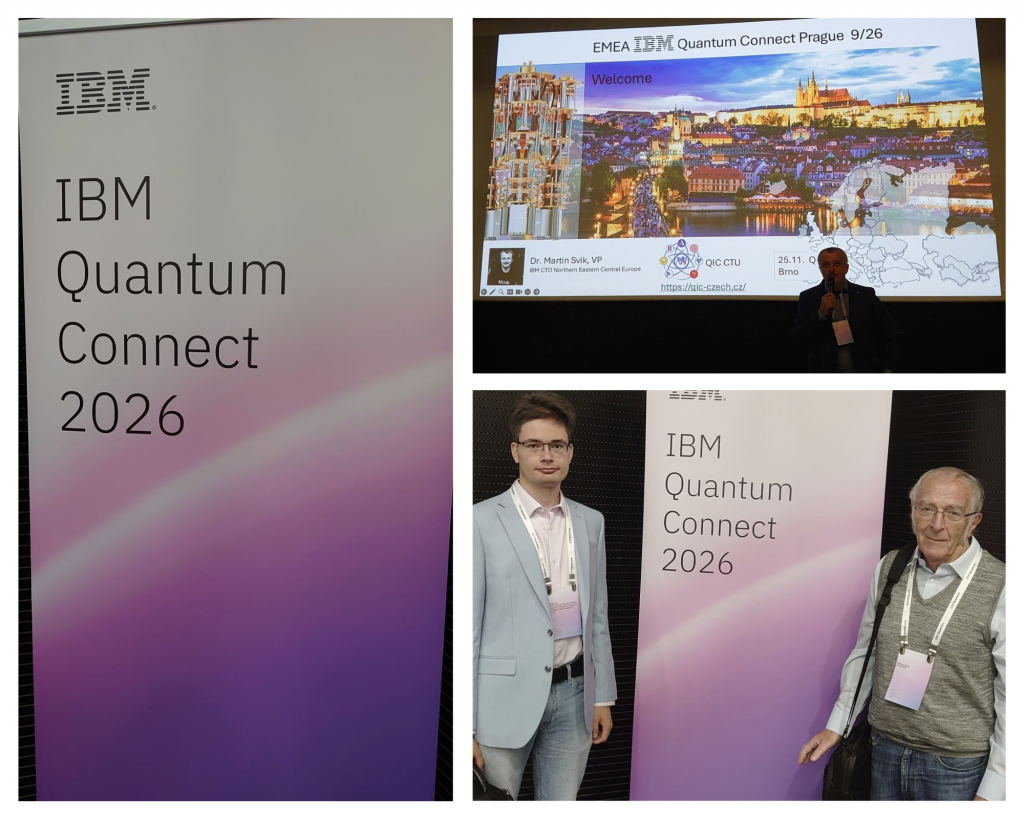
Our team recently attended IBM Quantum Connect Prague at the National Library of Technology! As active members of the Quantum Innovation Center (QIC) working on joint quantum projects, attending was a natural fit for us. The event showcased how quantum computing is moving from theory to practical applications across industry and academia, while providing a fantastic space […]
Seminar: AI-Based Stress Detection using Biosignals
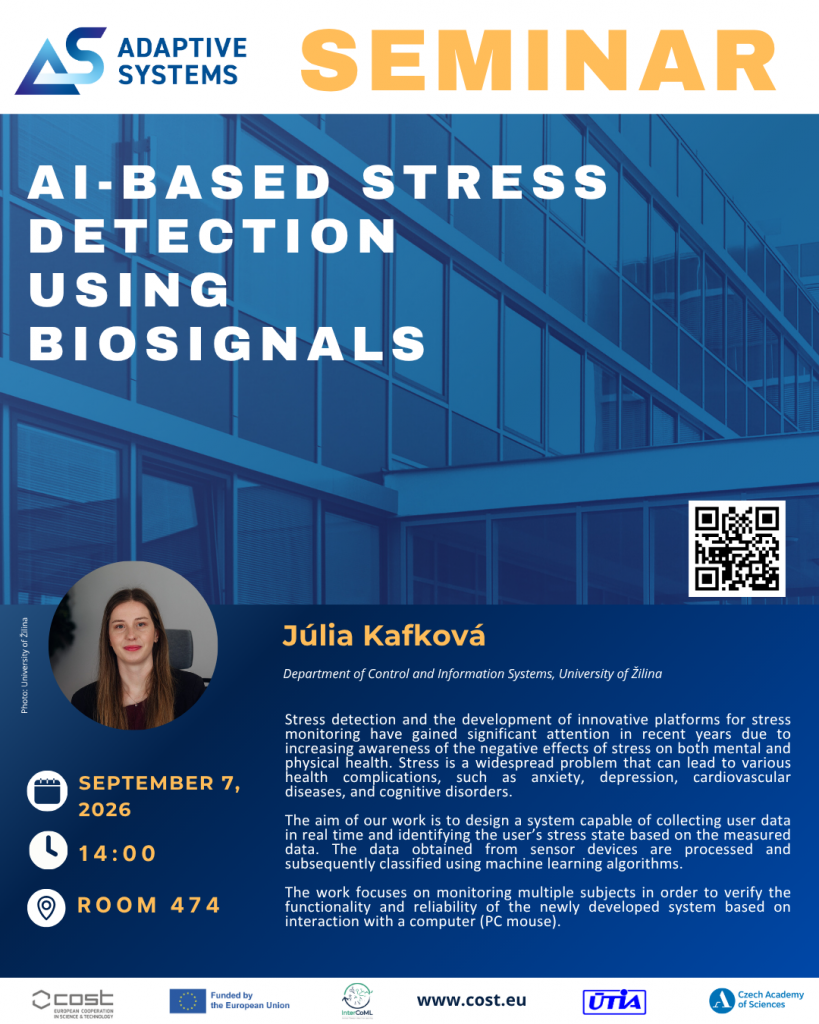
AI-Based Stress Detection using Biosignals Could the way you move your computer mouse reveal your stress levels before you even notice them? Stress is a widespread problem linked to anxiety, depression, and cardiovascular complications. Catching it early requires smart, seamless technology. Join us for a seminar exploring innovative platforms designed to track stress states in […]
A new paper on “Adaptive Bayesian point-mass estimation”!
Our new paper “Adaptive Bayesian point-mass estimation” has been published in the Journal of the Franklin Institute. The article is based upon work from COST Action InterCoML, CA24136, supported by COST (European Cooperation in Science and Technology) and by the Joint Laboratory TALISMAN. For more information: ScienceDirect COST – https://www.cost.eu/ ÚTIA – https://utia.cas.cz/en/ PEF CZU – https://www.pef.czu.cz/en COST (European Cooperation […]
Proud to contribute to the future of AI in law enforcement!
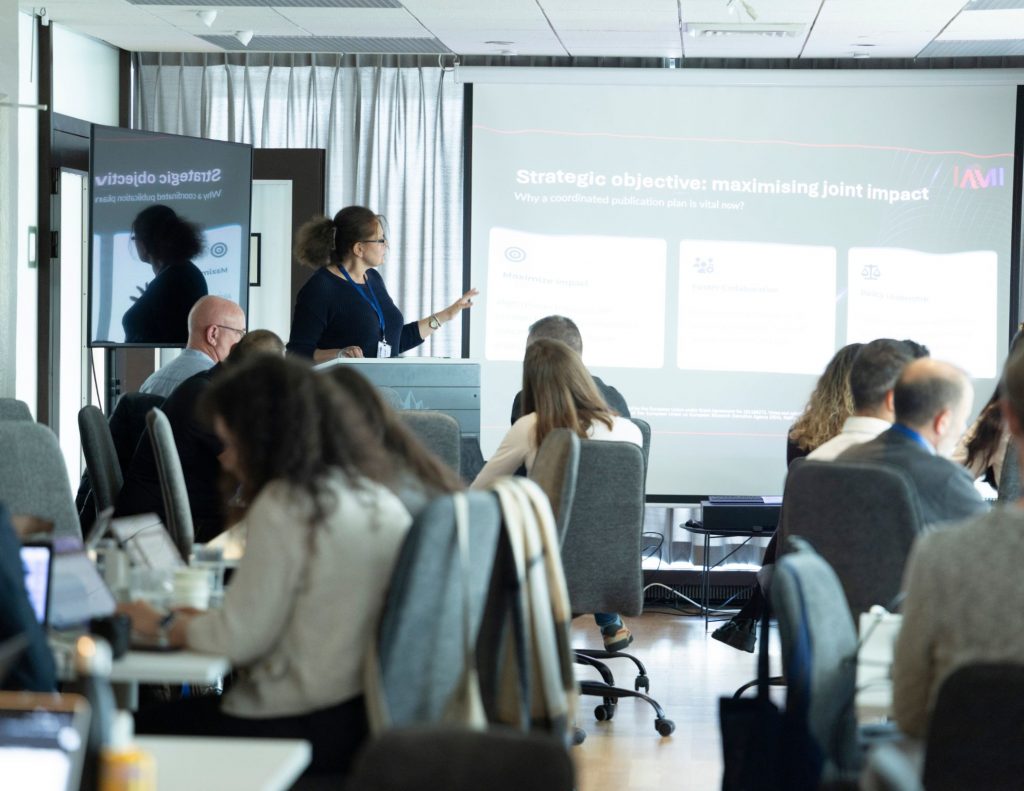
Our team at the Department of Adaptive Systems was happy to present our results at the 3rd IAMI Project Workshop in Reykjavík, Iceland (“From Enrolment to Intelligence: IAMI in Practice”). Alongside leading industry and research partners, we shared our latest insights on cutting-edge biometric technologies, AI-driven intelligence, and privacy-preserving solutions tailored for European Law Enforcement […]
Congratulations to Jurij Ružejnikov on completing the RLSS 2026 in Milan, Italy!

With a highly selective, peer-reviewed admissions process, the Reinforcement Learning Summer School (RLSS) brings together a focused group of researchers for an intensive ten-day program. Jurij worked through advanced material in AI theory, multi-agent systems, and LLM alignment—gaining hands-on perspective through discussion and research-driven collaboration. We look forward to integrating the specialized technical insights Jurij […]
Aleksej Gaj successfully graduated from IBM Quantum R2P

Road to Practitioner (R2P) is an invite-only IBM Quantum professional training program focused on practical mastery of the basics of quantum computing. Over the course of several months, participants deepen their understanding of the quantum mechanics principles relevant to computing technologies, become familiar with quantum algorithms, and work with tools such as Qiskit. Congratulations, Alex!
Visit of the Institute of Nuclear and New Energy Technology, Tsinghua University

In May 2026 our colleague Ondřej Tichý visited Dr. Sheng Fang at the Institute of Nuclear and New Energy Technology, Tsinghua University, Beijing. The visit focused on potential joint research in inverse modeling of atmospheric radionuclide releases and included discussions on collaborative project opportunities between the two institutions. More information about the research topic: https://as.utia.cas.cz/home/research/research-areas/estimation-of-unknown-source-of-atmospheric-release/ […]
Seminar with our guests from the Department of Cybernetics, FAV ZCU

We cordially invite you to an informal seminar organized by the AS Department, where we will welcome our guests from the Department of Cybernetics, Faculty of Applied Sciences, University of West Bohemia. Date and time: June 3, from 10:50 a.m. to 4:00 p.m. Location: Room 474, UTIA.
NextGen Synergy 2026: Successful International Scientific Meeting in Prague

Between 27–30 April, 2026, the international conference NextGen Synergy: Control Theory & Machine Learning was successfully held in Prague. Organised within the framework of the European COST Action CA24136 InterCoML, the event was run in collaboration of the Institute of Information Theory and Automation of the Czech Academy of Sciences and The Faculty of Economics […]
Seminar: Mast-Agent-AI

Mast-Agent-AI: A Hierarchical Multi-Agent Large-Language-Model Decision-Support System for Bovine Mastitis Diagnosis on Heterogeneous Dairy Data We would like to invite you to the Jan Saro seminar – Mast-Agent-AI: A Hierarchical Multi-Agent Large-Language-Model Decision-Support System for Bovine Mastitis Diagnosis on Heterogeneous Dairy Data Speaker: Jan Saro The seminar will be held on Monday, June 1, 2026 at 14:00 in […]